This article marks the launch of #HowItWorks, a series of technical features that explain the processes and systems behind our operations.
Kicking off the series is a feature on the recently inaugurated Tanawon Geothermal Power Plant, where we take a closer look at how geothermal energy is harnessed to generate clean, renewable power.
In support of the Department of Energy’s National Renewable Energy Program (NREP), which drives the country’s shift toward cleaner and more sustainable power sources, key industry players continue to collaborate in advancing renewable energy solutions. Among these, geothermal energy stands out as a promising source, harnessing the Philippines’ unique position along the Pacific Ring of Fire to produce reliable and sustainable energy.
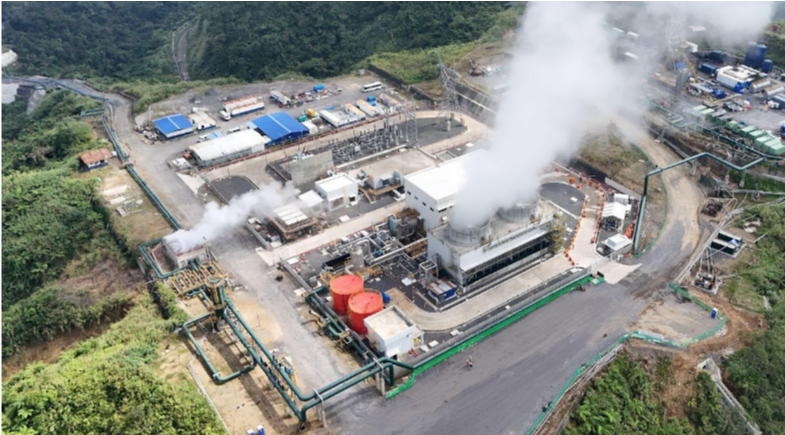
Aerial view of Tanawon Geothermal Power Plant taken last August 1, 2025 taken by Marinel Floralde
One of the recent geothermal power plants supplying electricity to the country is the Tanawon Geothermal Power Plant, inaugurated last August 1, 2025, in Sorsogon City. Developed by Energy Development Corporation (EDC), the project further expands the country’s geothermal capacity, strengthening the role of renewable energy in the power mix. EDC partnered with First Balfour as its contractor for the construction and installation of the Tanawon Geothermal Power Plant, including the Balance of Plant (BOP), Fluid Collection and Reinjection System (FCRS), and Connection Asset (CA), further strengthening a long-standing partnership built on advancing sustainable energy solutions.
How a Geothermal Power Plant Works
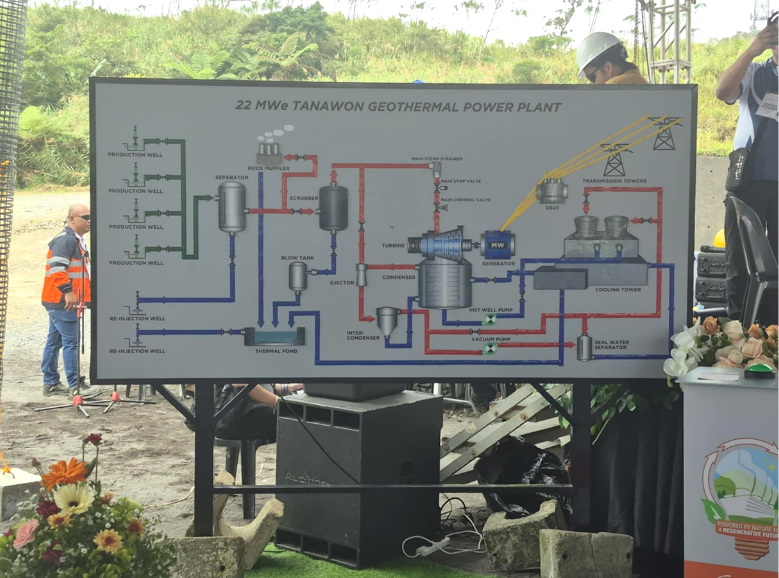
Diagram of the Tanawon Geothermal Power Plant presented during its inauguration on August 1, 2025. Photo courtesy of Energy Development Corporation.
The process begins with the collection of the mixture of steam and water/condensate discharged by the “Production Wells,” then transported via a pipeline system called the Fluid Collection and Reinjection System (FCRS) to a separator vessel, where fluid/condensate are separated from the steam before passing through a scrubber (to remove impurities and protect the turbine), and finally fed via the main control valve that regulates the steam flow entering the turbine.
The regulated steam flow drives the turbine to produce mechanical energy, which rotates the shaft of the electrical generator directly coupled with the turbine to produce electricity. The electricity generated by the generator is then connected to a “step-up” transformer to increase the voltage to a level compatible with the “Connection Asset” substation transformer. The stepped-up voltage electricity is then fed to the substation transformer to further increase the voltage to a level compatible with the “National Grid.” The Overhead Transmission Line delivers the generated electrical power to the National Grid System for electricity dispatching to the Power Grid.
The steam used to drive the turbine is then collected via the condenser through the hot well pump for circulation cooling at the cooling tower. Any remaining steam passes through an ejector, inter-condenser, and seal water separator for further condensation. Excess steam is safely released through the cooling tower.
Finally, all condensed fluid (known as brine) is collected in a thermal pond and reinjected into the geothermal reservoir through reinjection wells. This reinjection process helps sustain the geothermal resource and extend the lifespan of the field, ensuring a continuous and renewable supply of clean energy.
Future of Geothermal Power in the Philippines
As of 2023, the latest available data, the Philippines utilizes 1,900 MW of its 4,064 MW geothermal capacity. With the rising demand for power, more geothermal power plants are expected to be built across the country.
With the recent inauguration of the Tanawon Geothermal Power Plant, First Balfour strengthens its position as one of the country’s leading engineering and construction companies in the geothermal industry, contributing to the future of renewable energy in the Philippines.